Your team may speak
the same language
and still mean different things.
Culture shapes how people read confidence, respect, disagreement, authority, silence and trust. Third Culture Leadership helps leaders recognise those hidden signals, reduce costly misreading, and build shared ways of working across difference.

“A firm standard and human dignity can occupy the same sentence.”
The hardest cultural differences are often
the ones nobody names.
The assumptions that go unspoken.
Multicultural teams don't fail because people are difficult. They struggle because assumptions about how to communicate, how to disagree and how to show respect can stay invisible until they collide.
Third Culture Leadership gives leaders a structured way to surface those assumptions, clarify meaning and build shared team practices—without asking anyone to erase their identity.
A team member falls silent during a meeting. Their manager reads it as agreement. The silence meant unspoken concern.
Direct feedback is given as a mark of trust. It is received as a public attack. The relationship doesn't recover.
A decision is made and communicated. Two members assumed it needed unanimous consent. They keep re-opening it.
A leader opens the floor for input. The team waits for a direction. Both sides leave assuming the other wasn't engaged.
From Third Culture Kids
to Third Culture Leadership
The idea of a "third culture" dates back to the 1950s, when sociologists John and Ruth Hill Useem studied Americans living and working in India. They observed that when people from different cultural worlds interacted closely, they often created a shared way of relating that belonged fully to neither culture. The Useems called this emerging intercultural space the third culture.
Ruth Hill Useem later extended the idea to children growing up across cultures, coining the term Third Culture Kid (TCK) for those whose formative lives unfolded between their parents' culture and the societies in which they were raised. The concept was later developed and popularised further by David Pollock and Ruth Van Reken.
Third Culture Leadership builds on that lineage, but applies the underlying idea to leadership. Here, the "third culture" is not a nationality and not a compromise between two identities. It is the shared operating space that can be intentionally created when people with different cultural assumptions still need to work, decide, disagree, build trust and achieve outcomes together.
Third Culture Space is what the room can become.
Third Culture Leadership is how the leader helps make it so.
The terms "third culture" and "Third Culture Kid" originate in the cross-cultural research of John Useem, Ruth Hill Useem, David C. Pollock, and Ruth E. Van Reken. Third Culture Leadership is Promise Monday's leadership application of that underlying framework.

Beyond EDI: Becoming Culturally Fluent
Why diverse organisations need more than inclusion policies — they need leaders who can interpret, communicate and build trust across cultures.
Promise Monday
Paediatrician · Author · Founder, Third Culture Leadership
Insights for Leading Across Cultures



Four pillars for working
across cultural difference.
The Cultural Fluency Quotient (CFQ) is built on these four pillars. Together they form a practical framework for any leader or team navigating cultural complexity.
The operating system.
 01
01Self-Anchoring
Internal coherence.
Know who you are before you enter the room. Grounded leadership that does not fragment under cultural pressure.
Explore → 02
02Perspective-Shifting
Cultural sight.
Read other logics without losing your own. Understanding the reasoning behind difference.
Explore → 03
03Adaptive Communication
Clarity across difference.
Adjust how you communicate without changing what you stand for. Translating intent so meaning lands.
Explore → 04
04Relational Integration
Building together.
Create shared space where different cultural logics operate with dignity. Trust across difference.
Explore →Cultural Fluency Quotient
Twenty questions across the four pillars. A reflective tool for individuals who want to understand how they lead and work across cultural difference—not a performance measure or a hiring instrument.
Results are generated on your device. Responses are never stored.
Begin Assessment20 questions. These four pillars.
01Self-Anchoring
Internal coherence.
Know who you are before you enter the room. Grounded leadership that does not fragment under cultural pressure.
02Perspective-Shifting
Cultural sight.
Read other logics without losing your own. Understanding the reasoning behind difference.
03Adaptive Communication
Clarity across difference.
Adjust how you communicate without changing what you stand for. Translating intent so meaning lands.
04Relational Integration
Building together.
Create shared space where different cultural logics operate with dignity. Trust across difference.

Multicultural leadership requires more than goodwill.
helps you solve problems.
helps you manage emotion and relationships.
helps you interpret and adapt across cultures so trust can form, meaning can travel accurately, and outcomes land as intended.
When CQ is absent, leaders do not simply make mistakes. They misread people. They mislabel competence. They mistake silence for disengagement. They confuse deference with lack of initiative.
Bring the CFQ
into your live event.
Request a session code, share a single URL or QR code with your audience, and watch their results appear on screen in real time. No app, no participant sign-up.
Facilitator PortalRequest your session code
Submit your event name via the Facilitator Portal. Approved within 24 hours.
Share one link with your audience
Participants visit a URL or scan a QR code — no account or download required.
See band results live
Watch each participant's CFQ results arrive on your screen as they finish.
Where do you currently
lead from?
The Cultural Fluency Matrix maps how EQ and CQ interact across four distinct leadership profiles.
Explore the Matrix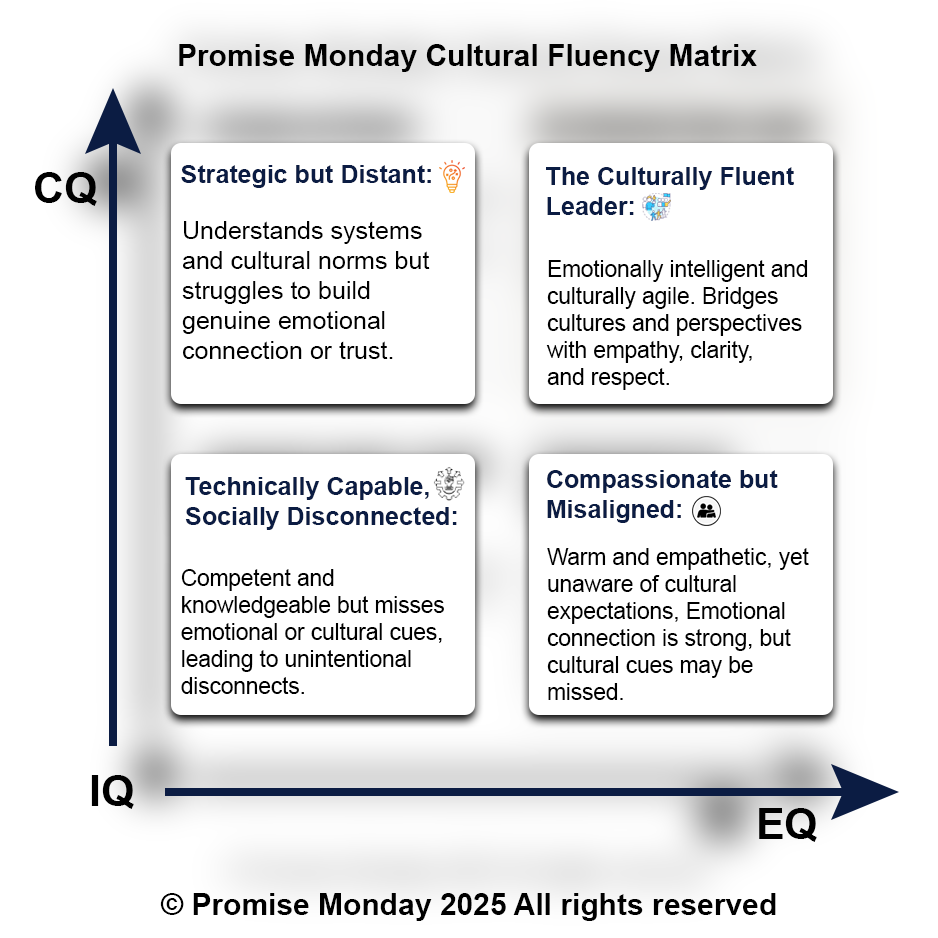
Develop your ability to work
across cultures.
Whether you manage across borders, collaborate in diverse teams or simply want to communicate more effectively with people from different backgrounds—the CFQ gives you a clear starting point.
Your results are private. Development goals are your own.
Take the CFQBuild trust and effective
collaboration in your team.
Facilitated workshops use the CFQ framework to give multicultural teams a shared language for navigating difference. Each participant takes the assessment with full informed consent. Sharing is always voluntary.
Sessions focus on awareness and practical next steps—not labelling.
Enquire about workshopsTrust. Dignity. Alignment. Performance.
Without it, people withdraw. Compliance replaces commitment. Teams become polite but fragile.
Once dignity is ranked by power, every decision becomes contaminated by resentment or fear.
Unity cannot be forced by sameness. It must be built through shared expectations and shared interpretation.
Leadership must still deliver. The point is not to avoid hard decisions, but to make them without damaging people.
These outcomes remain constant across sectors — whether you lead a hospital unit, a multinational organisation, a diplomatic mission, or a community initiative.
Speaking & Workshops
Keynotes and workshops for leadership teams, HR professionals and organisations navigating cultural complexity.
See speaking topicsBooks & Courses
Self-paced modules on cultural fluency, identity and leading across difference — plus published works by Dr Promise Monday.
Explore modulesArticles & Insights
Practical writing on leadership, communication and the realities of multicultural team life.
Read articlesCultural Fluency Mini-Course
Four structured modules on the pillars of Third Culture Leadership. Module 1 is free. Modules 2–4 are available individually or as a bundle.
Self-Anchoring
Establishing your cultural identity as a stable leadership foundation.
Start FreePerspective-Shifting
Developing the ability to read cultural situations through multiple lenses.
UnlockRelational Integration
Building trust, influence, and cohesion across cultural boundaries.
UnlockBest Value
All three paid modules — save £10
Modules 2, 3 & 4 together • £30 £20

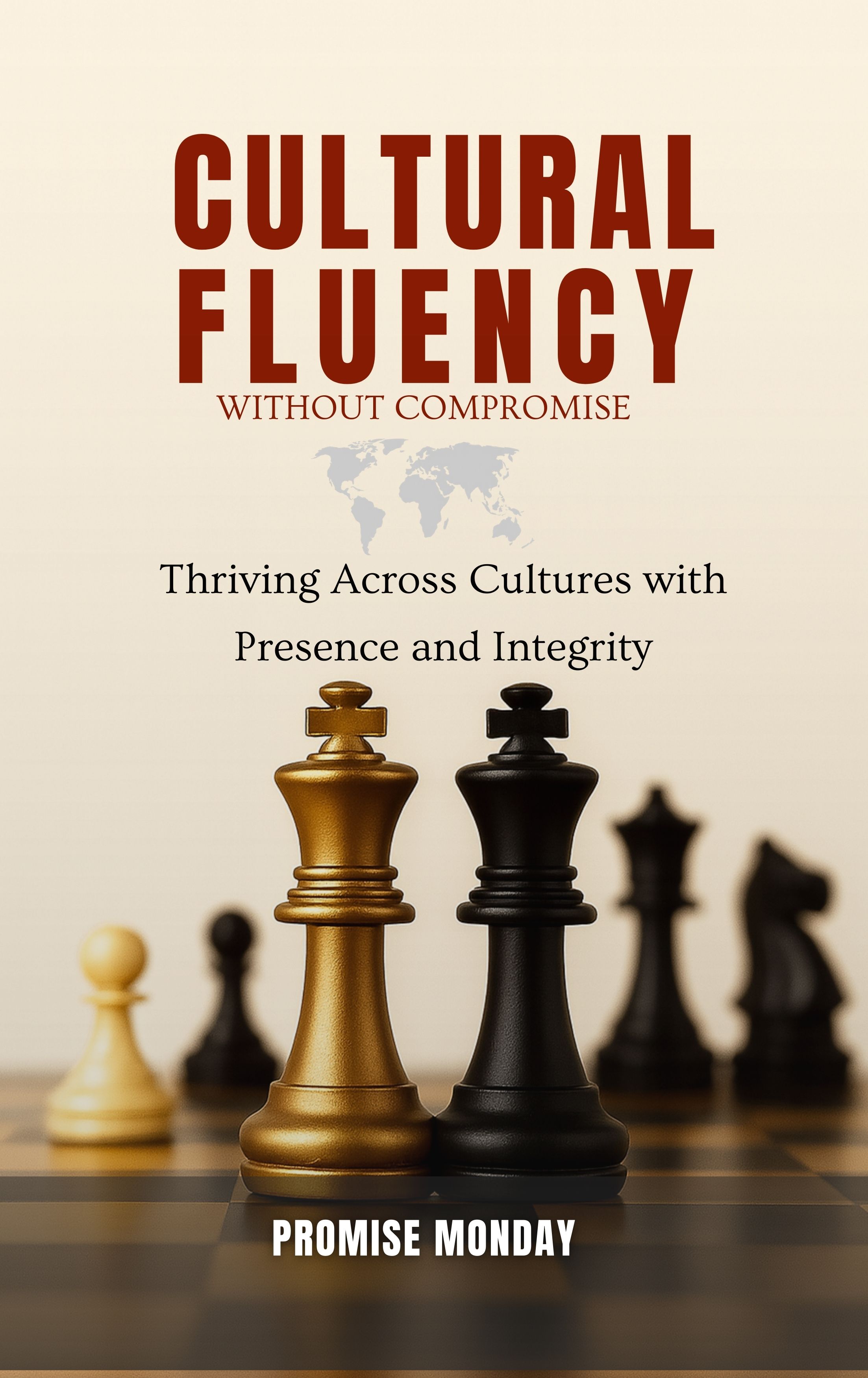
Cultural Fluency
Without Compromise
Dr Promise Monday • Promond Publishing • 2025
A framework for thriving across cultures without losing your identity. Introduces the "third culture" as a shared space—applied to leadership, teams and professional life.
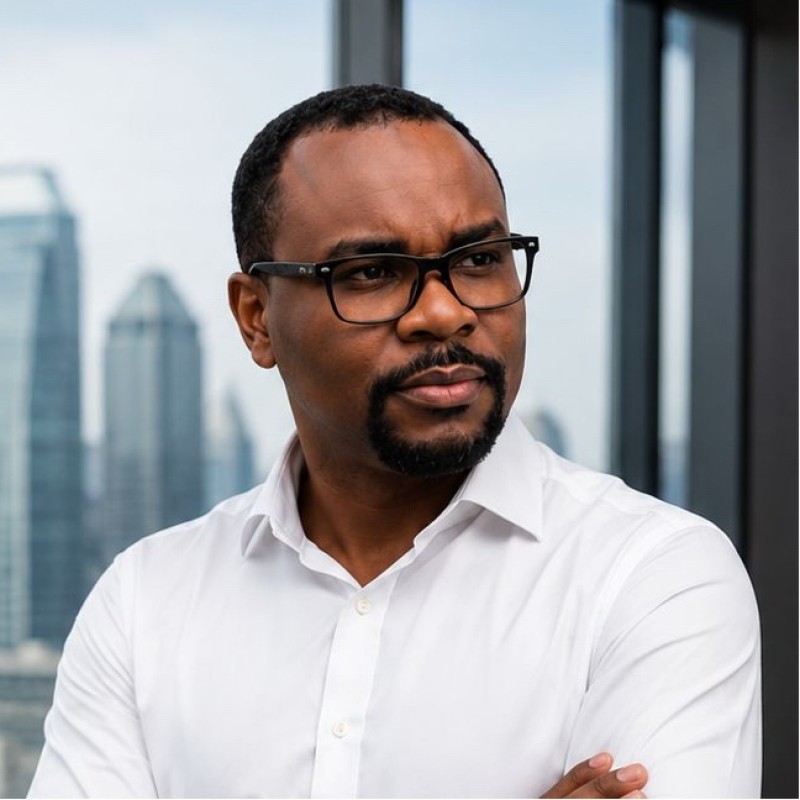
Dr Promise Monday
Paediatrician • Author • Founder, Third Culture Leadership
Third Culture Operating Language runs on kindness.
It is truth clothed in respect.
It is clarity without domination.
It is accountability without humiliation.
It is the deliberate refusal to treat difference as a reason to degrade.
Kindness is not softness. It is not indecision. It is not evasion. Third Culture Space becomes possible when leaders practise that discipline consistently.
Leading with cultural intelligence is not about geography. It is about having the agility to lead anyone, anywhere.
1 / 50
Cultural Fluency List
Stay close to the work
New essays, frameworks and session insights — delivered when they're ready, not on a schedule.
Ready to lead
across cultures?
Whether you are developing your own cultural fluency or building shared practices within your team, there is a clear next step.